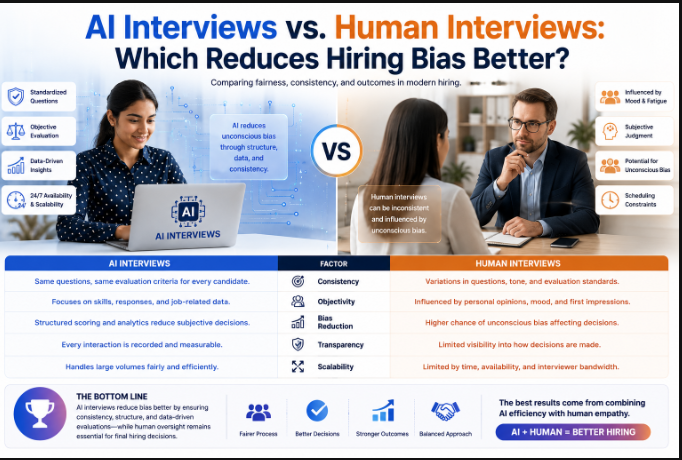
AI interviews reduce certain forms of hiring bias more consistently than human interviews because they apply the same evaluation criteria to every candidate, remove visual and demographic cues from scoring in many implementations, and eliminate interviewer fatigue and mood variance. Human interviews still hold an edge in detecting nuanced context and building candidate rapport, but they are far more vulnerable to unconscious bias, halo effects, and inconsistent judgment across interviewers. The most effective hiring processes in 2026 combine both, using AI interviews to standardize early screening and human interviews for final-stage judgment calls.
Why Hiring Bias Is Still a Major Problem
Bias in hiring is not a new issue, but it remains stubbornly persistent. Studies on resume screening and interview outcomes have repeatedly shown that identical qualifications receive different evaluations depending on a candidate’s name, accent, gender, age, or even the time of day the interview takes place. Human interviewers, no matter how well trained, bring an enormous amount of unconscious pattern matching into every conversation.
This matters for two reasons. First, biased hiring shrinks the talent pool a company can actually access, meaning qualified candidates get filtered out for reasons unrelated to job performance. Second, biased hiring creates legal exposure, especially as regulations around algorithmic and human decision making in employment continue to tighten worldwide.
Companies evaluating AI interviews as part of their hiring stack are usually trying to solve exactly this problem: how do you evaluate more candidates, more fairly, in less time.
How Human Interview Bias Actually Shows Up
Human bias in interviews rarely looks like overt discrimination. It shows up in smaller, harder to detect ways:
Halo effect. An interviewer who likes a candidate’s opening answer tends to score the rest of the interview more favorably, regardless of actual content.
Similarity bias. Interviewers unconsciously rate candidates who share their background, university, or communication style more highly.
Fatigue drift. Research on interview scoring shows candidates interviewed later in the day or later in a hiring cycle tend to receive lower scores simply because the interviewer is tired or has already found someone they like.
Inconsistent questioning. Two interviewers rarely ask the exact same questions in the exact same order with the exact same follow ups, which makes candidate comparisons less reliable than they appear on paper.
First impression anchoring. Decisions are often made within the first few minutes of an interview, with the rest of the conversation used to justify that initial judgment rather than test it.
None of this is intentional. It is simply how human cognition works under time pressure and repeated decision making. But it means that two equally qualified candidates can walk away with very different outcomes based on factors that have nothing to do with their ability to do the job.
How AI Interviews Approach the Same Problem
AI interviews are structured differently from the ground up. Instead of a human forming an impression and then evaluating against it, an AI interview platform typically works from a fixed rubric applied identically to every candidate.
Key mechanisms that reduce bias in AI interviews include:
Standardized questioning. Every candidate for a given role is asked the same core questions in the same format, removing variability introduced by different interviewers or different moods on different days.
Consistent scoring criteria. Responses are evaluated against predefined competencies rather than subjective gut feeling, which reduces the halo effect and anchoring bias common in human led interviews.
No fatigue or mood variance. An AI interview conducted at 9am produces the same evaluation standard as one conducted at 5pm on a Friday.
Reduced demographic signal exposure. Depending on the platform, AI interviews can be configured to focus scoring on response content rather than tone, accent, or appearance, which limits the influence of characteristics unrelated to job performance.
Auditable decision trails. Because scoring is rules based and logged, companies can review exactly why a candidate received a particular score, something that is nearly impossible to reconstruct after a subjective human interview.
This does not mean AI interviews are bias free. Algorithms are trained on data, and if that data reflects historical hiring patterns that were themselves biased, the model can inherit and even amplify those patterns. This is why responsible AI interview platforms build in bias auditing, regular model testing across demographic groups, and human oversight of edge cases rather than treating the algorithm as infallible.
Head to Head Comparison
| Factor | Human Interviews | AI Interviews |
| Consistency across candidates | Low, varies by interviewer and day | High, same rubric applied every time |
| Susceptibility to unconscious bias | High | Lower, but not zero |
| Fatigue or mood impact | Present and measurable | None |
| Ability to read nuanced context | Strong | Moderate, improving |
| Rapport building | Strong | Limited |
| Scalability for high volume hiring | Poor | Excellent |
| Auditability of decisions | Difficult | Straightforward |
| Risk of algorithmic bias if poorly trained | N/A | Present, requires monitoring |
Where Human Judgment Still Wins
It would be inaccurate to claim AI interviews are strictly superior in every dimension. Human interviewers are still better at reading emotional context, adapting follow up questions in real time based on subtle cues, and evaluating whether a candidate’s communication style will fit a specific team culture. These are areas where lived experience and situational judgment matter, and current AI interview technology is improving in this area but has not fully replicated it.
There is also a candidate experience consideration. Some candidates, particularly for senior or highly relational roles, expect and value a human conversation as part of the process. Removing that entirely can create a disconnect between the hiring process and the actual job, especially for roles that are heavily people focused.
The Case for a Hybrid Approach
The strongest bias reduction strategy for most companies is not choosing AI interviews or human interviews exclusively, but sequencing them intentionally.
A common and effective structure looks like this:
- Initial screening with AI interviews. Every candidate who meets baseline qualifications is evaluated using the same standardized AI interview, generating consistent, comparable data points across the entire applicant pool.
- Bias auditing on AI outputs. Hiring teams periodically review AI interview outcomes across demographic groups to confirm the model is not producing skewed results, adjusting the rubric or model as needed.
- Human interviews for shortlisted candidates. Once the pool is narrowed to a fair, standardized shortlist, human interviewers step in to assess team fit, communication style, and role specific judgment.
- Structured human interview scoring. Even at the human stage, using structured scorecards rather than open ended impressions helps limit the reintroduction of bias at the final stage.
This approach uses AI interviews to solve the scale and consistency problem while preserving human judgment where it adds the most value, at the final decision point with a smaller, already vetted group of candidates.
What Companies Should Actually Measure
Reducing bias is not just a philosophical goal, it is measurable. Companies adopting AI interviews as part of a bias reduction strategy should track:
- Pass through rates at each hiring stage broken down by demographic group
- Score distribution consistency across different interview time slots and interviewer panels
- Correlation between interview scores and actual on the job performance after hire
- Candidate feedback on fairness and clarity of the process
- Periodic third party or internal audits of AI interview scoring models
Without this measurement, it is impossible to know whether a hiring process, AI assisted or fully human, is actually reducing bias or simply relocating it somewhere less visible.
The Bottom Line
AI interviews reduce several of the most well documented sources of hiring bias, particularly inconsistency, fatigue, and unconscious pattern matching that human interviewers cannot fully eliminate even with training. Human interviews retain real value in contextual judgment and relationship building, particularly at final decision stages. Companies that get the best of both worlds are the ones treating AI interviews not as a replacement for human judgment, but as a standardization layer that makes the entire hiring process fairer, more consistent, and easier to audit before human interviewers ever enter the room.