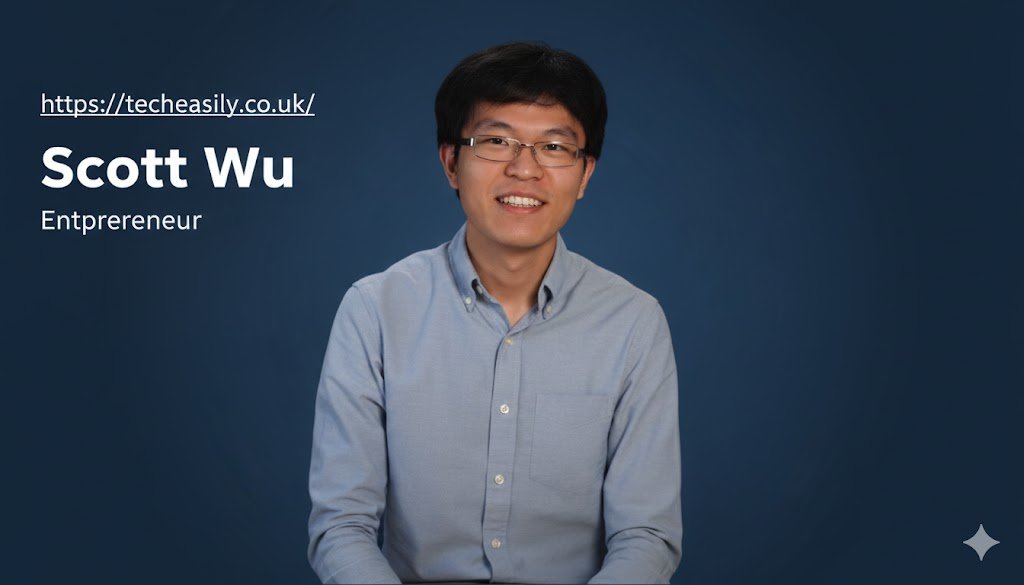
Scott Wu is a name rapidly gaining recognition in the tech world, particularly for his groundbreaking work in artificial intelligence and software engineering. As the co‑founder and CEO of Cognition AI, Wu has been at the forefront of a revolution in AI‑driven development tools, with his company’s flagship product, Devin, pushing the boundaries of what autonomous AI systems can achieve in the world of software engineering.
Early Life and Education
Born in 1997, Scott Wu’s path toward becoming one of the most innovative young tech entrepreneurs began in his early years. Growing up in Louisiana, USA, Wu showed an early aptitude for mathematics and computer science. His childhood was marked by a deep curiosity for problem‑solving and programming, skills that would eventually shape his career.
Wu’s academic journey began at Harvard University, where he pursued a degree in Economics. Although his academic focus may have seemed far removed from technology at first, his skills in mathematics and problem solving quickly made him a standout figure in the competitive programming world. Wu participated in numerous coding competitions, earning a reputation as a competitive programming prodigy. His achievements included winning gold medals at the International Olympiad in Informatics (IOI) and placing highly in global competitions like the ACM ICPC and Google Code Jam. These early accomplishments set the stage for Wu’s future as an entrepreneur and innovator.
Scott Wu The Birth of Cognition AI
In 2023, Scott Wu co‑founded Cognition AI, a company focused on building AI‑powered tools for autonomous software development. The company’s flagship product, Devin, is one of the world’s first autonomous AI software engineers, capable of writing, debugging, and optimizing code without human intervention. The product, designed to work alongside human developers, aims to make software engineering more efficient, scalable, and accessible.
Devin is a revolutionary tool that can autonomously understand coding tasks, complete them, and even suggest improvements. The idea behind Devin was to free human engineers from the more mundane aspects of coding, allowing them to focus on higher‑level problem solving and creative tasks. Wu’s vision is not to replace developers but to augment their abilities with AI, turning software development into a more collaborative process between humans and intelligent systems.
Under Wu’s leadership, Cognition AI has secured significant funding from top investors, including the Founders Fund, and has rapidly gained traction in the tech world. The company’s valuation skyrocketed as Devin’s potential became clear, with many experts predicting that AI-driven tools like Devin will be integral to the future of software engineering.
AI and the Future of Software Engineering
Scott Wu’s work with Cognition AI and Devin is a glimpse into the future of the software development industry. The ability for AI systems to autonomously handle coding tasks could change the way software is built — potentially reducing development times, increasing accuracy, and even making coding more accessible to those without deep technical expertise.
Devin’s ability to integrate with platforms like GitHub, Jira, and Slack means it can work directly within existing software development workflows, acting as a seamless addition to development teams. The product can take code snippets, generate complex algorithms, identify and fix bugs, and even propose code refactoring strategies. As AI becomes more involved in the development process, Wu believes that developers will be able to focus on more creative and challenging aspects of their work, while leaving repetitive tasks to intelligent systems.
The Vision for Cognition AI
Scott Wu’s ultimate vision for Cognition AI goes beyond just creating tools for software engineers. He believes that artificial intelligence will play a fundamental role in creating smarter, more efficient systems across various industries, from healthcare to logistics. At the core of his mission is the idea that AI can be a collaborative tool, one that works alongside humans to improve processes and productivity.
In interviews, Wu has spoken about his desire to create AI systems that do not replace human workers but rather enhance their abilities. This philosophy has shaped the development of Cognition AI’s products and has made the company stand out in an industry where concerns about AI replacing jobs are common. Rather than seeing AI as a threat, Wu views it as an opportunity for humans and machines to work together, creating a more dynamic and innovative future.
Scott Wu Entrepreneurial Journey
Before founding Cognition AI, Scott Wu was involved in several successful ventures, one of the most notable being Lunchclub, a professional networking platform powered by AI. Lunchclub used machine learning to connect professionals across industries, fostering valuable business relationships and expanding networking opportunities. Wu’s experience with Lunchclub gave him the insight and technical expertise to eventually launch Cognition AI and bring Devin to life.
Wu’s entrepreneurial journey has been one marked by innovation, ambition, and an ability to identify market needs. He has built his career on creating meaningful AI applications that push the boundaries of what technology can achieve. His deep technical background in competitive programming, combined with his vision for the future of AI, makes him a highly respected figure in the tech community.
Scott Wu Personal Life and Values
Despite his rapid rise in the tech world, Scott Wu remains grounded and values the work-life balance that he encourages in his team at Cognition AI. He is known for his hands-on leadership style and his ability to inspire those around him to be creative, innovative, and dedicated to building the best products possible. Wu has often emphasized the importance of fostering a collaborative environment, where employees can freely exchange ideas and learn from one another.
As a leader, Wu also recognizes the importance of mentorship. He has helped guide young engineers and entrepreneurs, offering his expertise and advice to those seeking to build careers in tech. His personal values are centered on integrity, innovation, and the belief that technology can be used to improve the world.
Net Worth and Recognition
While Scott Wu has not publicly disclosed his exact net worth, the success of Cognition AI and the Devin AI product suggests that he has accumulated significant wealth through his founder’s equity and successful ventures. As of 2025, Cognition AI’s valuation has placed it among the top emerging AI startups, with estimates indicating that the company’s value is approaching several billion dollars.
Wu’s achievements have not gone unnoticed. He has been featured in Forbes 30 Under 30 and other notable lists of young entrepreneurs and tech innovators. His work with Cognition AI continues to place him at the forefront of the AI revolution in software engineering.
The Future of Cognition AI
Looking ahead, Wu plans to continue pushing the boundaries of AI and its integration into the world of software development. Cognition AI’s focus is on making Devin AI smarter, more intuitive, and capable of taking on even more complex engineering tasks. With the support of investors and a growing team of AI experts, Scott Wu’s vision for the future of autonomous engineering is on the verge of transforming the tech industry.
Conclusion
Scott Wu is a visionary entrepreneur whose work with Cognition AI is poised to change the landscape of software engineering. His groundbreaking development of Devin AI, a tool that allows AI to autonomously write and debug code, is a testament to his commitment to innovating and pushing the limits of what AI can achieve. As he continues to lead Cognition AI, Wu’s passion for artificial intelligence and human-machine collaboration will undoubtedly play a major role in the tech world’s future.
Through his leadership, dedication, and vision, Scott Wu has proven himself not only as a brilliant technologist but also as an entrepreneur who understands the importance of innovation in building a better, more efficient future.