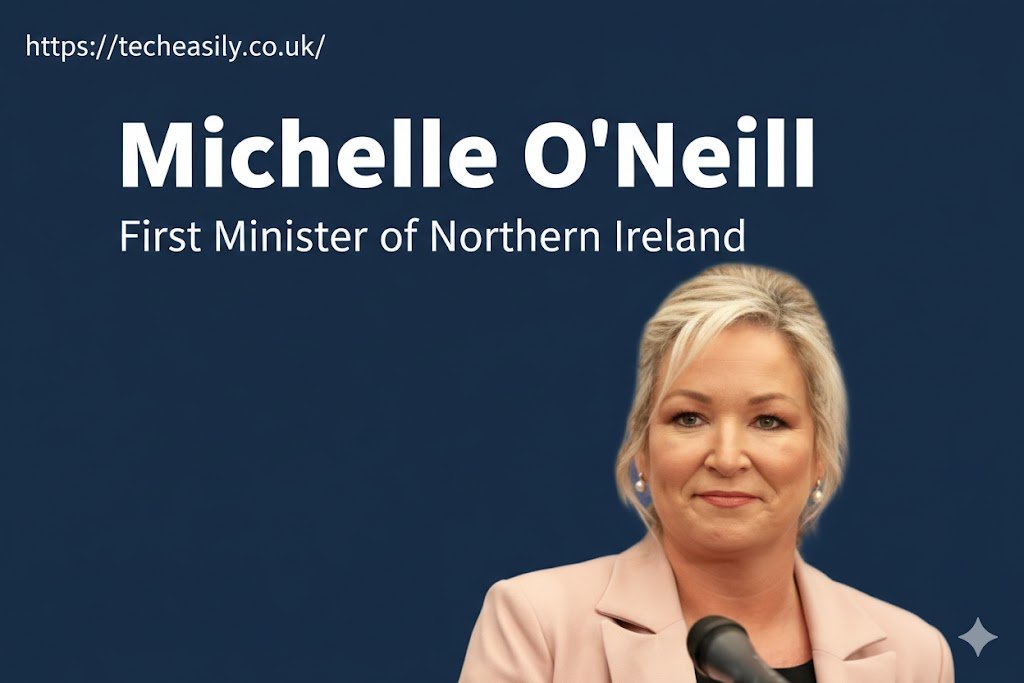
Michelle O’Neill, the First Minister of Northern Ireland, has carved out a remarkable path in the political landscape of both Northern Ireland and the Republic of Ireland. As the leader of Sinn Féin in Northern Ireland and the first nationalist to hold the office of First Minister in the region’s history, O’Neill’s journey reflects both her deep-rooted commitment to Irish republicanism and her willingness to engage in the complex, cross-community politics necessary to govern a divided society.
From her early days in a politically active family to her leadership in Sinn Féin, O’Neill’s rise to power represents a significant shift in Northern Ireland’s political dynamics. Her leadership not only challenges traditional power structures but also offers a new direction for the future of the region.
Early Life and Political Beginnings
Born on January 10, 1977, in Fermoy, County Cork, Michelle O’Neill grew up in Clonoe, County Tyrone. She comes from a family with strong Irish republican roots. Her father, Brendan Doris, was not only a Sinn Féin councillor but also a former Provisional IRA prisoner. Growing up in such an environment, O’Neill was immersed in the values of Irish nationalism and republicanism from a young age. This early influence would shape much of her political career.
Michelle O’Neill attended St. Patrick’s Girls’ Academy in Dungannon, where she excelled academically. However, she soon realized that her true calling lay in politics, particularly in advocating for Irish unity and social justice. After leaving school, O’Neill initially studied to become an accounting technician but quickly turned her focus to politics, joining Sinn Féin in 1998, the same year the Good Friday Agreement was signed. This agreement, which helped bring an end to decades of conflict in Northern Ireland, would play a pivotal role in O’Neill’s political formation and career.
Her political journey began at the grassroots level, and she soon became involved in local politics, working alongside Sinn Féin leaders in her community. By 2005, O’Neill was elected to the Dungannon and South Tyrone Borough Council, a position that marked the beginning of her formal political career.
Michelle O’Neill Rise through Sinn Féin and Ministerial Appointments
Michelle O’Neill rise within Sinn Féin was swift. In 2007, she was elected as a Member of the Legislative Assembly (MLA) for the Mid Ulster constituency. Her election marked a new chapter in her political life, as she became directly involved in shaping the policy direction of Northern Ireland. During her time in the Assembly, O’Neill became known for her strong stance on social justice issues, her commitment to Irish unity, and her determination to secure better conditions for working-class people in Northern Ireland.
In 2011, she was appointed Minister for Agriculture and Rural Development, a position she held until 2016. During this time, O’Neill worked tirelessly to address the unique challenges faced by rural communities in Northern Ireland. Her efforts to support local farmers and ensure the sustainability of rural economies earned her recognition across the political spectrum.
Michelle O’Neill next ministerial role came in 2016, when she was appointed Minister of Health. As health minister, she faced some of the most challenging issues in Northern Ireland, including budget cuts, the underfunding of public health services, and a growing demand for mental health resources. Despite these challenges, O’Neill was committed to improving healthcare access for all citizens, particularly in underserved areas.
Sinn Féin Leadership and the Road to Deputy First Minister
In January 2017, after the resignation of Martin McGuinness, Michelle O’Neill became the leader of Sinn Féin in Northern Ireland. This was a critical turning point in her political career, as she inherited the leadership of a party that had long been associated with the Irish republican movement. O’Neill’s leadership marked a departure from the older guard of Sinn Féin, as she was seen as a younger, more pragmatic leader who could guide the party into the next era.
Her tenure as leader of Sinn Féin in Northern Ireland saw the party make significant gains in elections. O’Neill’s leadership helped Sinn Féin become the largest nationalist party in Northern Ireland, challenging the dominance of unionist parties like the Democratic Unionist Party (DUP).
In January 2020, after the New Decade, New Approach agreement was signed, O’Neill was appointed Deputy First Minister of Northern Ireland, alongside Arlene Foster of the DUP. The role of Deputy First Minister, as outlined in the power-sharing arrangement of the Good Friday Agreement, required O’Neill to work closely with unionist partners to govern the region. Although the partnership was at times tense, O’Neill’s approach emphasized collaboration and compromise, reflecting her belief in the importance of unity in Northern Ireland.
However, her tenure as Deputy First Minister was not without challenges. The Northern Ireland Protocol, a post-Brexit agreement that placed a customs border between Northern Ireland and the rest of the United Kingdom, became a major point of contention. The DUP’s opposition to the Protocol led to political deadlock and ultimately to the suspension of the power-sharing government in 2022. O’Neill, however, remained steadfast in her commitment to the agreement and continued to advocate for Northern Ireland’s interests on the international stage.
Michelle O’Neill Becoming First Minister of Northern Ireland
After the 2022 Assembly elections, Sinn Féin emerged as the largest party in Northern Ireland, marking a historic shift in the region’s politics. This victory was a clear indication of the changing political landscape and the growing support for nationalist parties. As the leader of the largest party, O’Neill was positioned to become Northern Ireland’s next First Minister.
However, the path to the First Ministership was not smooth. The Democratic Unionist Party (DUP) refused to nominate a deputy First Minister in protest against the Northern Ireland Protocol, resulting in a prolonged political deadlock. Despite this challenge, O’Neill continued to push for the restoration of the power-sharing government and remained committed to her vision of a united, peaceful, and prosperous Northern Ireland.
Finally, in February 2024, after a long period of negotiation, the political deadlock was resolved, and O’Neill was sworn in as First Minister of Northern Ireland. This appointment marked a historic moment in the region’s history, as O’Neill became the first nationalist and Catholic to hold the office of First Minister. Her ascent to the top political position in Northern Ireland was a testament to her leadership and the growing influence of Sinn Féin in the region.
Challenges and Priorities as First Minister
As First Minister, Michelle O’Neill faces several significant challenges. These include navigating the aftermath of Brexit, managing the ongoing issues surrounding the Northern Ireland Protocol, and addressing the economic and social inequalities that continue to affect many communities in Northern Ireland.
One of O’Neill’s primary priorities has been to strengthen the Northern Ireland economy, particularly in the wake of Brexit. She has emphasized the importance of securing better trade agreements for Northern Ireland, which continues to face challenges in its relationships with both the European Union and the United Kingdom.
Michelle O’Neill is also committed to reforming public services, particularly healthcare and education, to ensure that they meet the needs of all citizens, regardless of their political or religious background. Her leadership in this area is crucial in fostering unity and healing the divisions that have long characterized Northern Ireland’s political landscape.
Michelle O’Neill Personal Life and Public Image
Michelle O’Neill personal life has often been in the public eye, particularly as she navigates the challenges of being a woman in a male-dominated political environment. O’Neill has been open about her background as a single mother, raising two children while pursuing a demanding political career. She has also been vocal about her struggles with public scrutiny and the pressures of leadership.
O’Neill is an advocate for women’s rights and has worked to promote greater gender equality in Northern Ireland. Her commitment to social justice extends beyond her work in politics, as she has been involved in numerous community initiatives aimed at improving the lives of vulnerable people.
Public Engagement and Controversies
As a leader in Northern Ireland, Michelle O’Neill is no stranger to public controversy. Her strong stance on Irish republicanism has drawn criticism from unionist politicians and some members of the public who view her political background with suspicion. However, O’Neill has always maintained that her primary goal is the well-being of the people of Northern Ireland, regardless of their political or religious affiliation.
One of the most notable public moments in her career occurred when she laid a wreath at the Belfast City Hall Cenotaph during Remembrance Sunday. This act was significant because Sinn Féin has traditionally been opposed to British symbols of remembrance due to the party’s historical links to the IRA. O’Neill’s wreath-laying, however, was seen as a gesture of reconciliation, demonstrating her commitment to representing all communities in Northern Ireland.
In addition, her presence at major events like the Coronation of King Charles III also sparked debate. O’Neill’s willingness to engage in these symbolic acts of unity reflects her leadership style — one that seeks to build bridges and move beyond the divisions of the past.
Conclusion
Michelle O’Neill political career is a testament to her resilience, vision, and commitment to change. From her early days as a councilor to her leadership of Sinn Féin and her historic appointment as First Minister, O’Neill has played a central role in shaping the political landscape of Northern Ireland.
Her leadership reflects a careful balance between Irish republican ideals and the pragmatic realities of governing in a post‑conflict society. As Northern Ireland navigates the complex challenges of the future, Michelle O’Neill will undoubtedly continue to play a pivotal role in the ongoing search for peace, unity, and prosperity.
O’Neill’s tenure as First Minister promises to be one of transformation, as she works to unite the diverse communities of Northern Ireland while maintaining Sinn Féin’s vision for a united Ireland. Her journey, from local politics to the top office, is one that will be remembered as a turning point in Northern Ireland’s history.