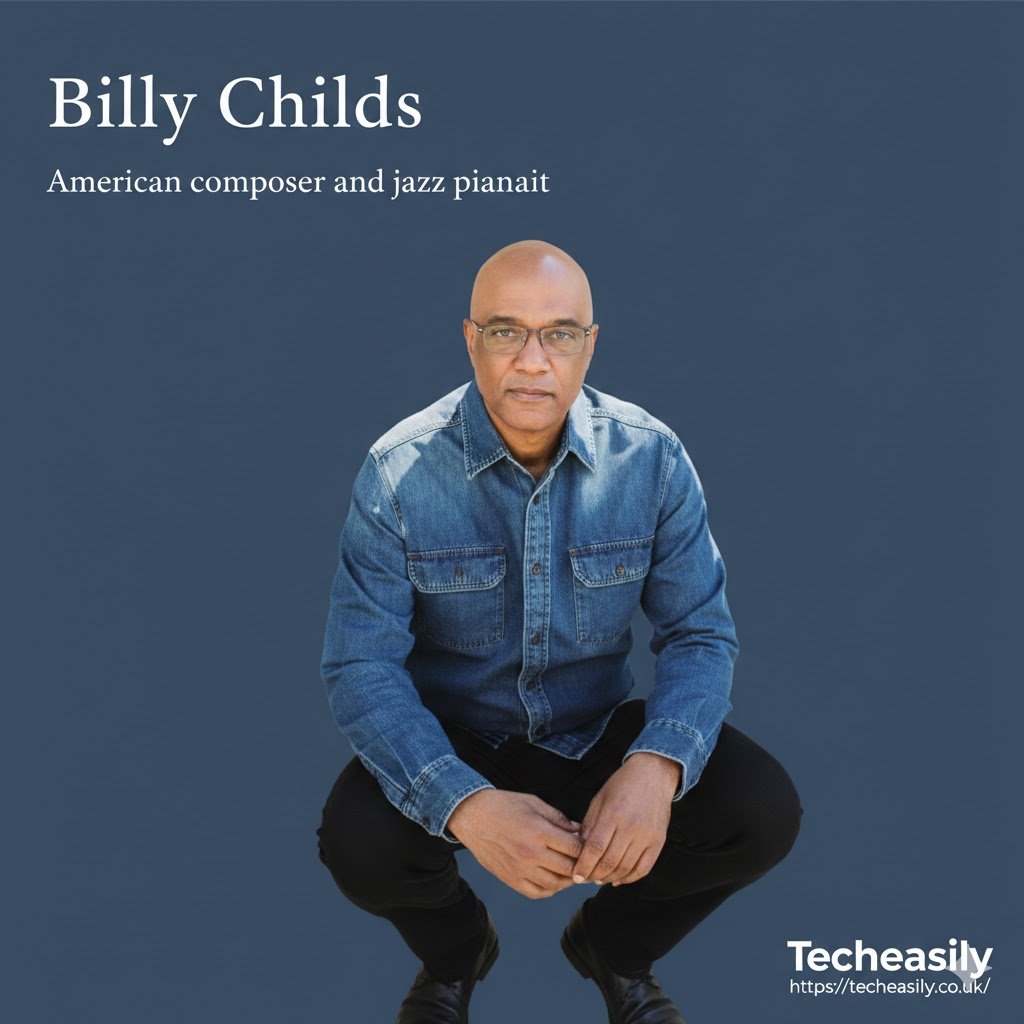
Billy Childs, born on March 8, 1957, in Los Angeles, California, is a name that resonates deeply within the world of jazz and contemporary composition. Renowned for his unique ability to blend the improvisational world of jazz with the structural intricacies of classical music, Childs has carved a path as one of the most influential American composers and jazz pianists of his generation.
Early Life and Musical Foundations
Billy Childs showed an early aptitude for music, taking piano lessons at the age of six. Raised in Los Angeles, he was exposed to a rich musical landscape that would influence his later work. Childs’s journey in music began with formal education, and by the time he was 16, he was already honing his skills at the Community School of the Performing Arts, affiliated with the University of Southern California (USC). It was at USC that he developed a deep foundation in music theory and composition, eventually earning a Bachelor of Music in Composition.
His early years were defined by a love of both jazz and classical music, and he began to blend these genres early on, shaping a style that would become his signature. This fusion of genres — characterized by the rhythm and improvisation of jazz and the precision and depth of classical music — would be the hallmark of his long and varied career.
Billy Childs A Rising Star in the Jazz World
Childs’s breakthrough came in the 1980s when he became a sought‑after pianist in the jazz community. He began working with a number of legendary jazz musicians, including Freddie Hubbard and J.J. Johnson, which allowed him to refine his skills and gain invaluable experience. His unique style caught the attention of the jazz world, and in 1988, he released his debut album, Take for Example, This…, a work that showcased his impressive technical skill and innovative approach to jazz. The album was a clear indicator of the path Childs would take — one that would blend jazz with more intricate and classical elements.
In the years following his debut, Childs continued to expand his repertoire. His work ranged from intimate jazz trio recordings to large‑scale orchestral compositions, showing his versatility and depth as a musician. His ability to seamlessly move between genres earned him a reputation as a true innovator in the music world.
Composition and Innovation: The Fusion of Jazz and Classical Music
Billy Childs’s compositions are a testament to his ability to bridge musical worlds. His work in jazz is rich with the spontaneity and improvisation that defines the genre, but it is also marked by sophisticated arrangements that draw on classical traditions. This hybrid style has led to a body of work that includes not only jazz albums but also orchestral and chamber music, making him one of the most versatile composers in contemporary music.
One of Childs’s most significant works is his chamber jazz ensemble, which combines jazz with strings, woodwinds, and other classical instruments. This blend of jazz rhythm sections with classical string quartets or brass quintets is a hallmark of Childs’s ability to push the boundaries of both genres. His orchestral compositions, such as those commissioned by the Los Angeles Philharmonic and other major institutions, have expanded his reach beyond the jazz world, bringing his innovative style to classical audiences as well.
Billy Childs Key Albums and Works
Throughout his career, Billy Childs has released a number of critically acclaimed albums that highlight his ability to blend genres. Some of his most notable works include:
- Take for Example, This… (1988): Childs’s debut album, which introduced his unique fusion of jazz and classical elements.
- Twilight Is Upon Us (1989): An album that further explored the blending of jazz with orchestral arrangements.
- I’ve Known Rivers (1995): A work that garnered widespread praise for its depth and complexity.
- Rebirth (2017): A Grammy‑winning album that showcased Childs’s continued ability to innovate and inspire.
- The Winds of Change (2023): A Grammy Award‑winning album that captured Childs at his best, blending his jazz quartet sound with fresh, contemporary elements.
These albums, among others, showcase Childs’s growth as an artist and his unwavering commitment to musical exploration and excellence. His work has also earned him numerous Grammy nominations and awards, further cementing his place as one of the leading figures in modern jazz.
Billy Childs in the Jazz Community
Billy Childs’s contributions to jazz extend beyond his solo recordings. Over the years, he has worked as a session musician, producer, and arranger, collaborating with a wide range of jazz luminaries, including Dianne Reeves, Chris Botti, Yo‑Yo Ma, and Sting. His ability to create intricate arrangements and orchestrations has made him a highly sought‑after collaborator in both the jazz and classical worlds.
In addition to his work with other artists, Childs has also been involved in educational initiatives to pass on his knowledge to the next generation of musicians. His passion for teaching and mentoring young jazz pianists and composers has contributed to his legacy as not just a performer and composer, but as a mentor and leader in the jazz community.
Awards and Recognition
Throughout his illustrious career, Billy Childs has earned multiple Grammy Awards, including wins for Best Jazz Instrumental Album and Best Instrumental Arrangement. He has also received numerous honorary distinctions, such as the Doris Duke Performing Artist Award and a Guggenheim Fellowship, further highlighting his status as one of the most important figures in contemporary music.
His innovative contributions to both jazz and classical music have solidified his place as a composer who has consistently pushed the boundaries of music. Childs’s ability to create music that resonates across genres and audiences is a testament to his skill and vision as an artist.
Legacy and Influence
Billy Childs’s influence extends far beyond his recordings and performances. His compositions and arrangements have inspired countless musicians, composers, and listeners. He has proven that music is not confined to one genre; instead, it is a fluid art form that can bring together the best elements of jazz, classical, and contemporary music.
Childs’s work continues to evolve, and his ability to fuse different musical traditions ensures that his legacy will endure for generations to come. Whether performing with his jazz quartet, composing for orchestras, or collaborating with other artists, Billy Childs remains a towering figure in the music world.
Conclusion
Billy Childs is not just a jazz pianist — he is a composer, innovator, and musical visionary whose work has reshaped the landscape of contemporary music. From his early days in Los Angeles to his Grammy‑winning compositions, Childs’s career is a testament to the power of music to transcend genres and bring people together. His legacy is one of innovation, dedication, and artistry, ensuring that his contributions will be remembered and celebrated for years to come.