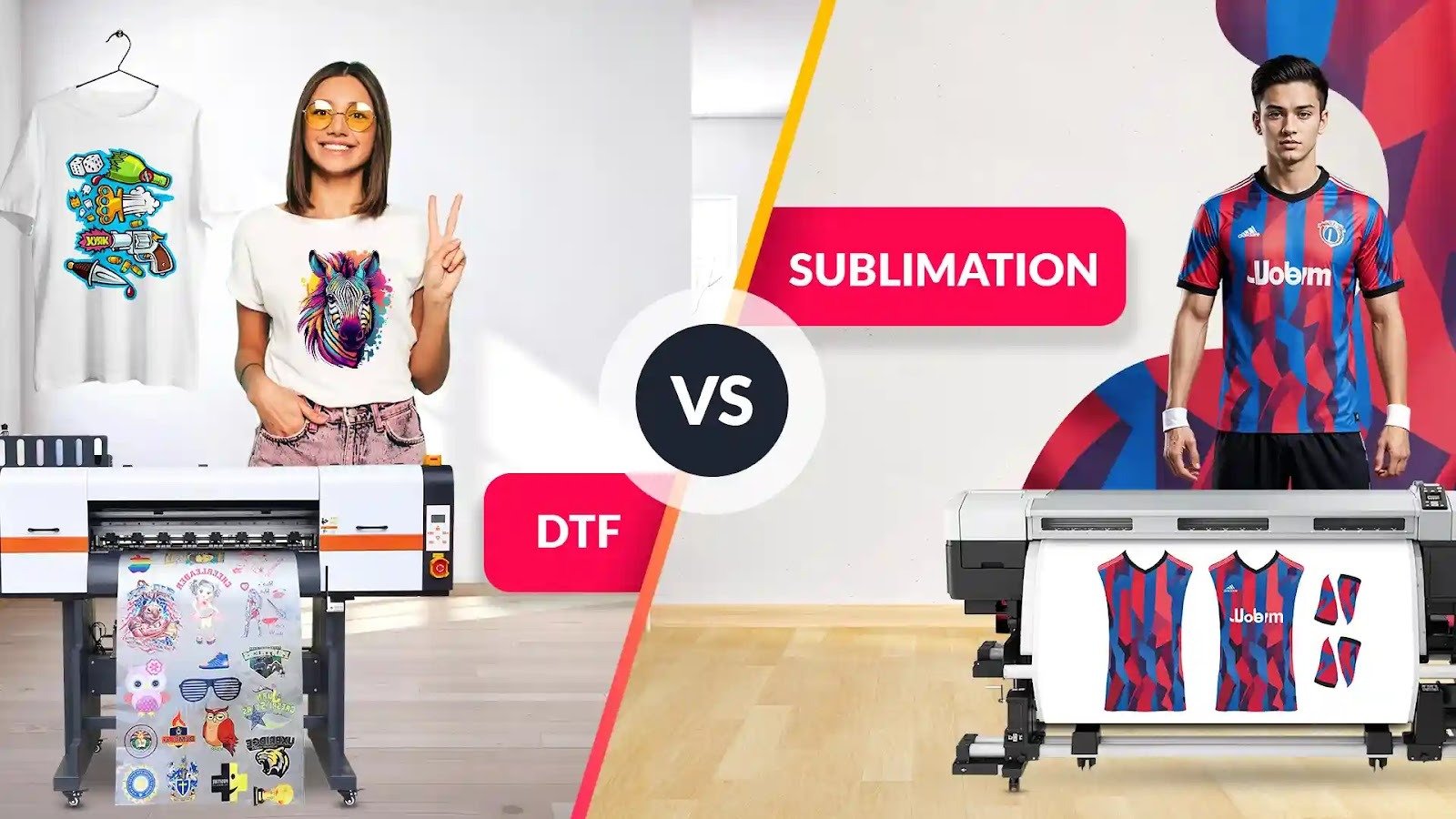
Direct-to-Film (DTF) printing and sublimation printing are the most commonly used technologies for digital printing of textiles. Both techniques use specialised inks to create colourful and long-lasting patterns on clothes. But DTF and sublimation ink are different in their composition, printing process, and application.
Printing professionals or manufacturers need to understand the use of both DTF and sublimation ink. So they can choose the most appropriate method to use in their production requirements. Both inks have certain benefits with respect to the type of fabric used, the design needed, and the scale of production.
What Is Sublimation Ink?
Sublimation ink is completely based on a chemical process. It uses sublimation transfer paper to print the design. The printed paper is loaded onto polyester fabric. The ink remains in a solid state when subjected to heat and transforms straight into a gas. After it, gas penetrates into polyester fibres and bonds with them permanently.
The following are properties of sublimation ink:
- Unlike DTF printing, the sublimation ink is not deposited on the surface of the fabric.
- The basic feature of using sublimation ink is that the colour becomes a component of the fabric.
- Sublimation ink has a dye-based ink formulation.
- One of the main characteristics of this ink is everlasting colour bonding of polyester fibres.
- And the last one is, none of the cracking or peeling occurred after several washes.
What Is DTF Ink?
DTF ink plays a key role as a pigment ink in the Direct-to-Film printing process. This ink is used to print a design on a PET film. After applying adhesive powder to wet ink, the pattern is applied to the cloth. The design is transferred to fabric with the help of heat and pressure.
DTF printing is able to print detailed designs on numerous materials due to the features of DTF ink.
DTF ink has specific properties:
- DTF ink has good bonding with adhesive powder.
- To give good colour coverage, DTF ink is an ideal choice.
- It is used for the longevity of prints on a wide variety of textile-based materials.
- DTF ink has a high pigment concentration for bright colours.
- The key feature of DTF inks is their compatibility with dark-coloured fabrics and white ink.
Differences in the Printing Process: DTF Ink vs Sublimation Ink
The printing processes for both production techniques are quite different.
DTF printing requires PET film, adhesive powder, DTF ink, and curing equipment. Sublimation printing typically needs fewer materials. This ink is restricted to polyester products.
There are also businesses that compare the specifications of the equipment, compatibility of materials, and workflow of printing technology. Product information and printing resources are also available at https://www.dtflinko.com/. Whereby digital printing solutions are offered in a professional production environment.
The major differences are discussed below:
- In the DTF Printing process, ink is used to print the design on a PET film. On the other hand, for sublimation, the ink is converted to gas using a heat press.
- Unlike DTF ink, sublimation ink is embedded into the fabric. This feature gives a smooth print.
- The most significant difference between these two types of ink is fabric compatibility. DTF ink is compatible with cotton and polyester. It is also suitable for fabric blends, nylon, and leather.
- Sublimation ink is used to print polyester banners, promotional products, and coated mugs. This ink is compatible with fabrics like polyester sportswear and performance jerseys.
- The colour performance of both techniques is also different. Bright colours and high contrast are made possible by DTF ink. On dark garments, the patterns can be seen because of white ink layers. Sublimation ink is used to give vivid colours to light polyester fabrics. Nonetheless, it does not print white ink.
- DTF ink has high colour accuracy and is appropriate for complicated designs. On the other hand, sublimation ink does not work on dark fabrics.
- Both types of ink are of good durability. Neither ink can peel off the fabric. Also, both are good at washing resistance.
- The applications of DTf ink include custom apparel printing. It is ideal for a mixed fabric product line.
- Sublimation printing is the most popular in those industries that deal with polyester materials.
- Sublimation ink is perfect for printing promotional products and performance fabric.
Conclusion
In digital textile printing, DTF and sublimation inks are used to serve various purposes. DTF ink is also versatile and can be used on most types of fabrics, such as cotton and blends. Sublimation ink is very durable and easily integrated with colour, but it only works with polyester materials.
There are numerous printing firms that are still experimenting with new digital printing technologies and materials. Knowledge of the difference between these inks enables printing professionals to choose the most suitable solution for their work. Supplier reliability and quality of ink are also critical factors for businesses that compare DTF ink and sublimation ink with various production requirements. Companies evaluating suppliers and production partners can click here to review DTF ink manufacturers involved in the digital printing industry.