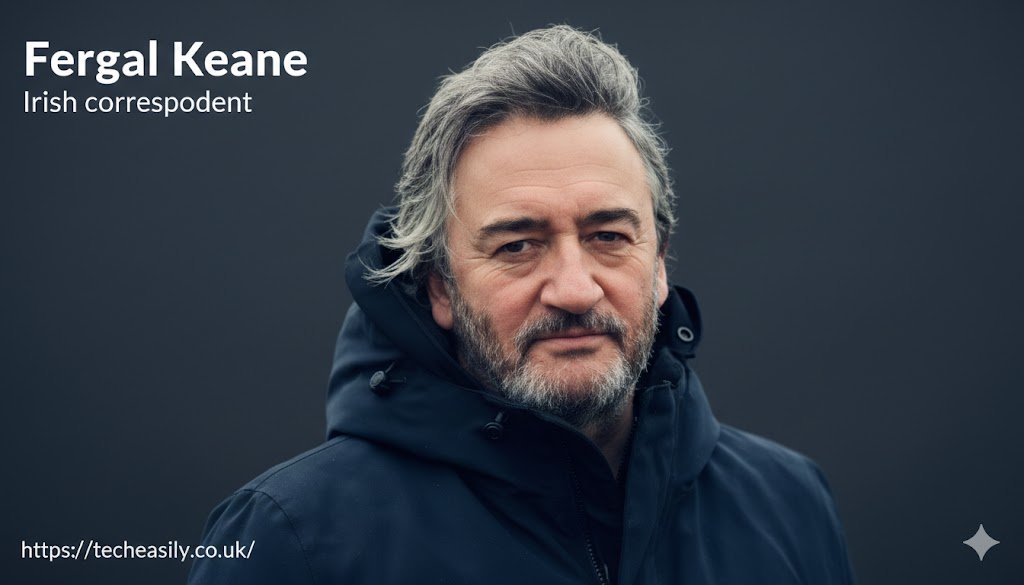
Fergal Keane, one of the most respected foreign correspondents of his generation, has spent decades reporting from conflict zones around the world. Known for his deep empathy, unwavering commitment to truth, and distinctive storytelling, Keane has covered some of the most harrowing events of the late 20th and early 21st centuries. His work has not only brought global attention to critical issues but has also reshaped how audiences view war and its human impact.
Early Life and Inspiration
Born on January 6, 1961, in London, Fergal Keane was raised in Ireland, where his father, Eamonn Keane, was an actor, and his mother, Maura Hassett, was a teacher and actress. Growing up in an environment steeped in storytelling and the arts, Keane was drawn to both language and social issues from a young age. His interest in current affairs, combined with a passion for writing, naturally led him toward a career in journalism.
Keane attended Presentation Brothers College in Cork and later went on to study at Trinity College Dublin, where his academic focus helped lay the foundation for his later career in foreign reporting. It was during this time that Keane became increasingly aware of the power of journalism to shape public understanding of global events.
Fergal Keane Breaking into Journalism
Keane began his journalism career in 1979 when he started writing for The Limerick Leader. Over time, he honed his reporting skills, eventually moving to The Irish Press, where his work gained wider recognition. His early career helped him build a robust understanding of the complexities of Irish politics and society, a background that would later serve him well as he began reporting on international conflicts.
In 1989, Keane joined the BBC, where he would spend the next several decades as one of the most prominent foreign correspondents of his time. His move to the BBC marked the beginning of a new chapter in his career, one that would take him to the frontlines of some of the world’s most significant and dangerous conflicts.
Fergal Keane Reporting from the Frontlines
Keane’s early assignments took him to Northern Ireland, where he covered The Troubles, a period of violent conflict that deeply affected the region. His reporting on The Troubles was characterized by a focus on the human stories behind the headlines — the lives torn apart by violence, the families left behind, and the communities struggling to survive amid political chaos.
In the 1990s, Keane became the BBC’s Southern Africa Correspondent, where he reported on South Africa’s transition away from apartheid, a landmark moment in history. His coverage of this shift, coupled with his first‑hand reporting from the heart of the Rwandan genocide in 1994, cemented his reputation as a journalist who could bring both depth and humanity to his coverage of global tragedies.
Keane’s work during the Rwandan genocide, where an estimated 800,000 people were killed in just a few months, was especially impactful. His reporting captured not only the scale of the tragedy but also the personal stories of those affected by it. He has often cited his time in Rwanda as one of the most harrowing experiences of his career, but also as a defining moment that solidified his commitment to human‑centered journalism.
The Madness of War: Keane’s Approach to Reporting
Throughout his career, Keane’s reporting has been guided by a singular principle: to tell the stories of people, not just politics. His ability to convey the emotional and psychological toll of war and conflict has set him apart from other journalists in his field. Keane has never been content to simply cover the events of a war — he sought to understand its impact on the individuals caught in its wake.
This approach has led him to cover not only traditional war zones but also the emotional aftermath of conflict. Whether reporting from Kosovo, Iraq, or Afghanistan, Keane’s writing consistently brings a human element to the forefront. His empathetic storytelling has earned him the admiration of both his peers and audiences worldwide.
Books and Personal Reflections
Beyond his work as a foreign correspondent, Keane has written several books that provide deeper insights into his life as a journalist and the conflicts he has covered. His books blend memoir, history, and reportage, offering a unique perspective on the global issues of our time.
- Season of Blood: A Rwandan Journey (1995) — a deeply personal account of the Rwandan genocide, blending on‑the‑ground reporting with Keane’s emotional response to the horrors he witnessed.
- Letter to Daniel: Dispatches from the Heart (2002) — a collection of dispatches written for his son, offering reflections on his work as a journalist and the toll it took on him personally.
- Wounds: A Memoir of War and Love (2019) — a memoir exploring Keane’s experiences as a journalist, including his struggles with PTSD as a result of covering intense conflict zones.
- The Madness: A Memoir of War, Fear, and PTSD (2022) — an exploration of the emotional and psychological toll that war reporting has had on Keane, offering an unflinching look at his battle with post‑traumatic stress disorder (PTSD).
In his books, Keane not only chronicles the tragedies he reported on but also reflects on his own personal journey — the emotional costs of war, the challenges of balancing family life with the demands of his profession, and the long‑term impact of witnessing human suffering.
Fergal Keane Personal Life: Family and Advocacy
Keane is married to Anne Frances Flaherty, a journalist and writer, since 1986. Together, they have two children — a biological son, Daniel, and an adopted daughter, Holly. The Keane family has navigated the challenges of balancing family life with Keane’s high‑profile career, with Anne providing vital support as her husband reported from some of the most dangerous and volatile regions in the world.
Keane is a passionate advocate for mental health awareness, particularly regarding the psychological toll of war reporting. His own struggles with PTSD have inspired him to speak openly about the condition, encouraging others to seek help and support. Through his documentaries and public speaking, Keane has worked to raise awareness of the challenges faced by journalists and others exposed to trauma.
Legacy and Recognition
Fergal Keane’s career has been marked by numerous accolades, including BAFTA awards, Emmy Awards, and the Peabody Award for his contributions to journalism. His influence extends beyond his own work, as he has paved the way for future generations of journalists to approach conflict with compassion, integrity, and humanity.
Keane’s legacy is not just in his reporting but also in the conversations he has sparked about the psychological toll of war journalism. His decision to speak openly about his own struggles with PTSD has been a powerful step in breaking the silence surrounding mental health in journalism, and his willingness to advocate for change in the industry has made him a respected figure both in journalism and in the broader public discourse.
Conclusion
Fergal Keane’s career is a testament to the power of journalism to shine a light on the darkest corners of the world. Through his decades of reporting from conflict zones, his books, and his advocacy for mental health, Keane has reshaped the way we think about war, reporting, and the emotional cost of bearing witness to human suffering. His work stands as a powerful reminder of the importance of telling the human stories behind the headlines and the responsibility of journalists to approach their craft with empathy, courage, and integrity.