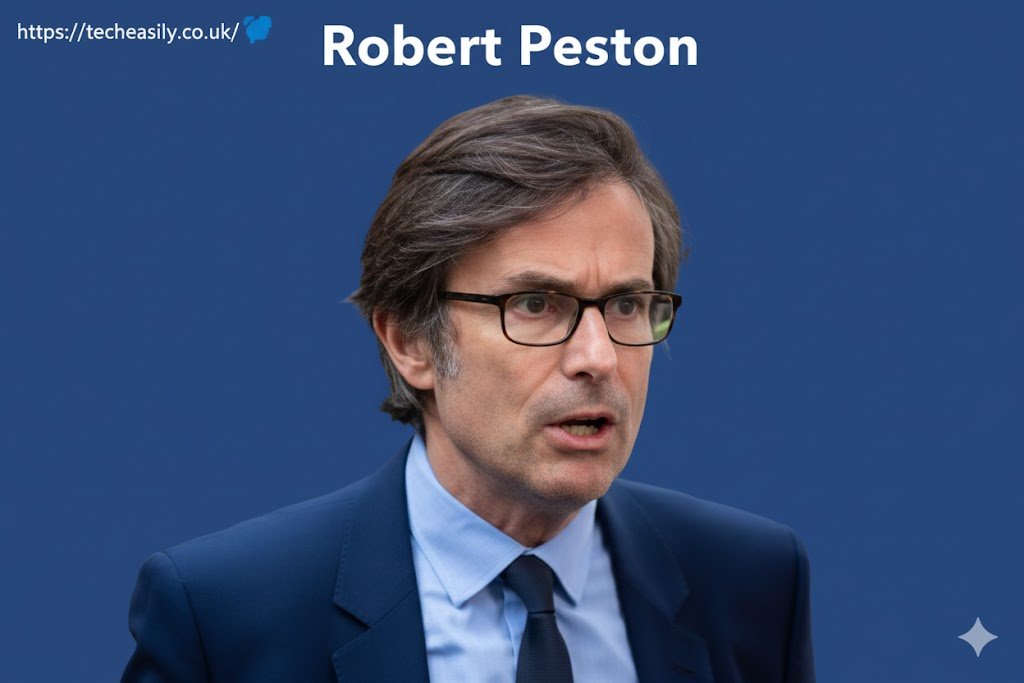
Robert Peston is one of the most influential figures in contemporary British journalism. With a career spanning several decades, Peston has established himself as a sharp, insightful, and often provocative voice on financial and political matters. Known for his deep understanding of economic systems, his ability to break big news stories, and his candid approach to complex issues, Peston has earned a reputation as one of the foremost journalists in the UK.
Early Life and Background
Born on April 25, 1960, in London, England, Robert Peston hails from a family deeply rooted in academia and public service. His father, Maurice Peston, was a well-known economist and Labour peer, which exposed Robert to political and economic discussions from an early age. This background would later shape his career and approach to journalism.
Peston attended Balliol College, Oxford, where he studied Philosophy, Politics, and Economics (PPE). This combination of academic disciplines provided him with a strong foundation in the areas that would later dominate his professional life: politics, economics, and societal issues.
Breaking into Journalism
Robert Peston’s career in journalism began in the early 1980s, initially working in finance before transitioning into full-time journalism. He started at The Investors Chronicle, a UK-based business publication, where he worked as a reporter. From there, he moved on to various roles in the media, eventually landing at The Independent, where he worked as a business correspondent.
His big break came when he joined the Financial Times in 1991, where he continued to develop his skills as a reporter and economic analyst. Peston’s expertise in financial reporting allowed him to cover a wide range of topics, from banking to corporate scandals, and it wasn’t long before he became a household name in British financial journalism.
The BBC Years: A Period of Major Exposure
In 2005, Robert Peston made the move to BBC News as the Business Editor, a role that thrust him into the public eye. During this time, Peston became known for his coverage of major economic events, particularly his reporting on the 2007–2008 global financial crisis. His detailed analysis of the financial meltdown, including his exclusive reporting on the troubles at Northern Rock, helped solidify his reputation as a top economic journalist. His coverage of the crisis was widely praised for its clarity and depth, making complex financial topics accessible to the general public.
During his time at the BBC, Peston’s distinctive style — a mix of calm analysis, dry wit, and his signature “Peston voice” — became iconic. His work didn’t just break news; it explained the implications of that news in a way that made it understandable to a broader audience.
Transition to ITV: New Ventures and the Peston Show
In 2015, Robert Peston made the bold decision to leave the BBC and join ITV News as their Political Editor. At ITV, he became known not just for his reporting but also for his hosting role on the Peston show (formerly Peston on Sunday). The program provided a platform for in-depth political discussions and interviews with key figures, further cementing Peston’s place as one of the leading voices in political journalism.
Peston’s move to ITV marked a significant shift in the way political discussions were presented on British television. He was able to carve out a unique space, combining hard-hitting political reporting with a more relaxed and conversational format that allowed him to engage with guests in a way that was both informative and entertaining.
Robert Peston Personal Life: Challenges and Triumphs
Despite his public prominence, Robert Peston has maintained a relatively private personal life. However, his relationship with Siân Busby, a writer, became widely known. The couple married in 1998 and had one son together. Tragically, Siân passed away in 2012 after a battle with cancer. Robert has spoken candidly about the grief he experienced after her death, and he has often referenced how this personal loss shaped his approach to life and his work.
In 2018, Peston became publicly involved with Charlotte Edwardes, a journalist who worked for The Sunday Times. The couple’s relationship sparked media interest, and Peston’s personal life has continued to be a topic of discussion, especially following his openness about his emotional experiences and challenges.
Robert Peston Legacy in Journalism
Robert Peston’s career in journalism has been marked by a number of key achievements:
- Financial Crisis Coverage: His reporting during the 2007–2008 financial crisis is often cited as some of his best work. He was able to provide clear and accessible explanations of complicated economic issues, such as bank failures and the housing market collapse.
- Political Reporting: As ITV’s Political Editor, Peston’s coverage of UK politics, particularly during the tumultuous years of Brexit and General Elections, helped keep the public informed about key political developments.
- Innovative TV Journalism: Through shows like Peston, Robert Peston has redefined how political news can be delivered. His engaging style, combined with his expert analysis, has made political discussions more accessible and engaging for audiences.
Peston’s ability to break major stories, explain complex topics, and engage with the public has earned him widespread recognition as one of the most respected journalists in the UK.
Robert Peston Personal Views and Political Influence
As a journalist, Peston has always been committed to providing objective and balanced reporting. However, his personal views often make their way into his work, particularly in the context of economic inequality and the effects of financial crises on everyday people. Peston has never shied away from commenting on issues such as wealth disparity, corporate greed, and the role of government in regulating financial institutions.
He has also been vocal about his belief in the importance of the media in holding the powerful to account. His editorial work, both in print and on television, often reflects a deep concern for transparency, social justice, and the role of government in shaping the economy.
Books and Authorial Work
In addition to his work as a journalist, Robert Peston is also an author. His book, “How Do We Fix This Mess?” (2017), is a look at the economic challenges facing the UK and the world. The book provides readers with a detailed analysis of the financial systems that led to the 2008 financial crisis and offers potential solutions to the problems facing modern economies.
Peston’s writing style is similar to his broadcasting approach — clear, concise, and focused on explaining complex issues in an easily understandable way. His books have been well-received and add another layer to his multifaceted career in journalism.
Current Work and What’s Next for Robert Peston?
As of 2025, Robert Peston continues to be a central figure in British political and economic journalism. His work on ITV remains vital in shaping the national conversation on politics and the economy. Additionally, his podcast, The Rest Is Money, continues to offer in-depth analysis of financial issues.
While much of his focus remains on UK politics and economics, Peston’s ability to adapt to new media formats, like podcasting, ensures that his influence will continue for many years to come.
Conclusion
Robert Peston’s career has been defined by his ability to break stories, explain complex issues, and engage with the public in a meaningful way. As a journalist, he has earned a reputation for his deep expertise, his commitment to clarity, and his willingness to tackle difficult topics head-on.
His legacy in journalism is one of integrity and insight, and as he continues his work in TV, radio, and print, there is no doubt that Robert Peston will remain one of the most influential voices in British media for years to come.