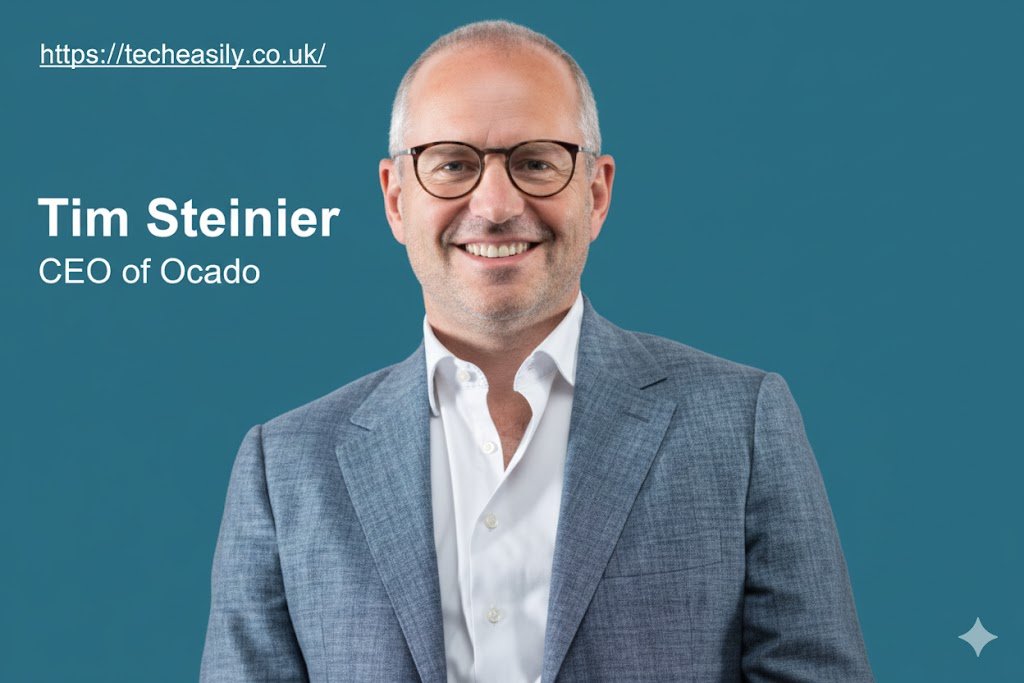
Tim Steiner, widely known as the co-founder and CEO of Ocado, has become one of the most prominent figures in the tech and retail industries. Under his leadership, Ocado, the UK’s leading online grocery and technology company, has grown from a small startup to an international leader in automation and online grocery delivery.
Early Life and Background
Born on December 9, 1969, Tim Steiner grew up in North London. His academic journey began at Haberdashers’ Boys’ School, an esteemed institution in Hertfordshire. After excelling in school, he went on to study Economics at the University of Manchester, where he began to develop an interest in business and finance.
Steiner’s first professional role was in the world of finance. After graduation, he joined Goldman Sachs as a bond trader, where he worked in their offices across London, New York, and Hong Kong. However, despite his success in the financial sector, Steiner was driven by a desire to create something of his own. In 2000, he made the bold decision to leave Goldman Sachs and co-found Ocado alongside his colleagues Jonathan Faiman and Jason Gissing.
Tim Steiner The Founding of Ocado: A Tech-Driven Revolution in Grocery Retail
The idea for Ocado stemmed from Steiner’s frustration with the traditional grocery shopping model. The three co-founders saw an opportunity to combine the convenience of online shopping with the logistical challenges of the grocery business. Their vision was clear: to create an online-only grocery retailer that could rival the established supermarkets.
The company began with a partnership with Waitrose, the UK’s premium supermarket chain. Initially, the idea seemed risky, as there was no major online grocery retailer at the time. But the trio’s persistence and belief in the potential of their business model paid off. Ocado quickly became a success, gaining attention for its innovative approach to online grocery shopping.
One of the biggest breakthroughs for Ocado was its warehouse automation technology. As the company scaled, it became clear that the only way to meet growing demand and maintain efficiency was through automation. In 2006, Ocado opened its first automated warehouse in Hatfield, marking a major milestone in the company’s journey.
Steiner’s vision for Ocado extended beyond just retail. He sought to transform the entire grocery supply chain through cutting-edge technology. This led to the development of the Ocado Smart Platform, a suite of software and robotics systems designed to help other retailers improve their operations. Today, Ocado Technology licenses this technology to other global retailers, revolutionizing the grocery industry beyond the UK.
Tim Steiner Leadership and Ocado’s Growth
As CEO, Tim Steiner has been instrumental in guiding Ocado through several significant stages of growth. Under his leadership, the company expanded rapidly, moving beyond its original partnership with Waitrose. Ocado entered new partnerships with Marks & Spencer and other global players. The company also began expanding internationally, signing major deals to license its technology to retailers in countries like the United States and Canada.
In 2010, Ocado went public, listing on the London Stock Exchange. The IPO was a major achievement for Steiner and his team, marking the company’s transition from a startup to a publicly traded corporation. While Ocado’s stock has faced ups and downs, it remains a key player in the online grocery and retail technology sectors.
Under Steiner’s guidance, Ocado has become an innovator in the realm of automation, investing heavily in robotics and AI to revolutionize warehouse management. This has positioned Ocado at the cutting edge of the online grocery industry, allowing it to meet customer demand more efficiently and maintain a competitive edge in an increasingly crowded marketplace.
Financial Impact: Tim Steiner Net Worth and Compensation
As the CEO of Ocado, Tim Steiner’s financial success has been closely tied to the company’s performance. His net worth has grown substantially over the years, with estimates ranging from £400 million to £600 million based on his ownership of Ocado shares, bonuses, and stock options.
In addition to his equity holdings, Steiner’s salary and bonuses have also attracted attention. Over the years, he has received significant compensation packages, often linked to the company’s financial performance and share price. In 2019, for example, Steiner’s total remuneration package reached an eye-watering £58.7 million, a number that drew public scrutiny. This reflected the company’s strong growth prospects and the potential of its technology.
Despite the heavy criticism of high executive pay, Steiner’s compensation is seen as a reflection of Ocado’s success as a tech company and the demand for its cutting-edge automation systems. However, his salary and bonuses have remained a topic of debate, with some questioning the fairness of large payouts in a company still investing heavily in its future.
Personal Life: Family and Relationships
Tim Steiner has always been a relatively private figure when it comes to his personal life. However, some details have made their way into the public domain, particularly regarding his marriage and children.
Steiner was previously married to Belinda Steiner, and the couple has four children. However, the marriage ended in a high-profile divorce, which attracted media attention due to the size of their assets and the couple’s wealth.
Following his divorce, there were reports of Steiner’s relationship with Patrycja Pyka, a Polish model. Though details of their relationship remain largely private, it was reported that they were living together after Steiner’s separation from his wife.
There has been no public information confirming whether Steiner has remarried or entered into a new long-term partnership.
Legacy and the Future of Ocado
Tim Steiner’s legacy will likely be defined by his transformation of the grocery industry. Through his vision, Ocado has become a global leader in automation technology, with its robotics, AI, and warehouse systems now being licensed to major retailers around the world.
In addition to his work at Ocado, Steiner’s leadership has shown that technology and logistics can have a profound impact on traditional industries like grocery retail. His commitment to innovation and automation has set the stage for a future where Ocado’s technology could potentially power the next generation of retail across industries.
As Ocado continues to grow and expand globally, Tim Steiner’s focus will likely remain on continuing to scale Ocado Technology while also maintaining the retail arm’s position as a leading force in online grocery shopping.
Conclusion
Tim Steiner’s journey from Goldman Sachs bond trader to the CEO of Ocado is a testament to the power of innovation and bold vision. Through his leadership, Ocado has revolutionized the online grocery industry and become a key player in global retail technology. His ongoing commitment to automation and AI will likely define his career as he continues to push the boundaries of what’s possible in the world of logistics and retail.