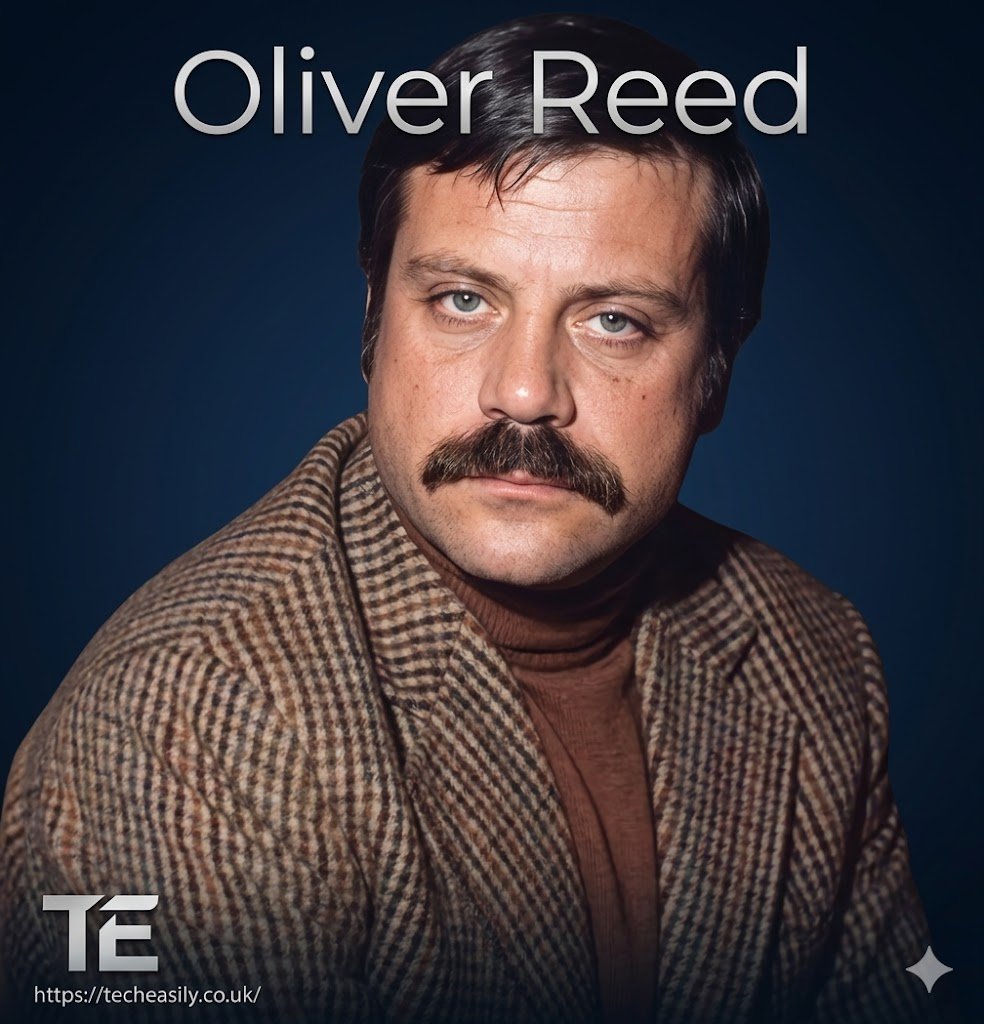
Oliver Reed, an English actor renowned for his intensity and rugged screen presence, remains one of the most memorable and captivating figures in British cinema. With a career spanning more than four decades, Reed made his mark through a series of complex and often controversial roles in both British and international films. Known for his memorable performances in historical epics, dramas, and adventure films, Reed’s career was as colorful and larger-than-life as the characters he portrayed.
Early Life and Beginnings in the Film Industry
Oliver Reed was born on 13 February 1938 in Wimbledon, London, into a family deeply connected to the world of theatre. His father, a journalist, and his uncle, Sir Carol Reed, a famous film director, shaped Reed’s early exposure to the entertainment industry. Reed’s interest in acting developed from a young age, but his early career was not without challenges.
Before breaking into film, Oliver Reed spent time working as a carpenter and had a brief stint in the army before deciding to pursue a career in acting. He trained at the National Youth Theatre and began appearing in minor roles in film and television in the late 1950s. His early work included uncredited parts, but Reed’s imposing physical presence quickly set him apart from his contemporaries.
Oliver Reed Breakthrough Roles and Stardom
Oliver Reed breakthrough came in 1961 when he was cast in the film The Curse of the Werewolf, in which he portrayed a tortured and tragic werewolf. The film garnered attention for Reed’s powerful performance, marking the beginning of his rise in British cinema. Throughout the 1960s and 1970s, Reed became known for playing tough, muscular, and morally ambiguous characters, a persona that suited his real-life personality.
One of his most iconic roles was in 1968 when he played Bill Sikes in Oliver!, the Oscar-winning adaptation of Charles Dickens’ Oliver Twist. His portrayal of the violent and menacing Sikes won him international recognition and cemented his place as a powerful presence in film. Oliver Reed ability to bring a raw intensity to his roles earned him a reputation as one of the most commanding actors of his time.
Throughout the next decade, Reed continued to take on challenging and diverse roles, such as in Women in Love (1969), where he starred opposite Glenda Jackson, and The Devils (1971), where he played a priest involved in a controversial historical drama. His performances in these films showcased his versatility, blending physicality with emotional depth.
Oliver Reed Iconic Roles and Later Career
The 1970s and 1980s saw Oliver Reed continue to build his filmography with high-profile films, including The Three Musketeers (1973) and The Four Musketeers (1974), in which he played Athos, one of the titular musketeers. These films were hugely successful, cementing Reed’s status as a box-office draw.
In the 1980s, Reed’s career slowed somewhat, but he still managed to land notable roles in films like Castaway (1986) and The Adventures of Baron Munchausen (1988). His versatility allowed him to shift between genres, tackling everything from romantic drama to sword-and-sorcery adventures.
One of his most beloved roles in his later career came in 1995, when he played the gruff but lovable circus owner Mr. Bruno in the film Funny Bones. This performance was a departure from his earlier intense characters, showing a gentler and more nuanced side of Oliver Reed acting talent.
The Gladiator Legacy and His Final Role
In one of his most iconic final roles, Oliver Reed appeared in Ridley Scott’s 2000 epic, Gladiator. He portrayed Proximo, a former gladiator who trains and mentors Russell Crowe’s Maximus. Reed had finished filming most of his scenes before his untimely death, and his last role was tragically cut short. However, Reed’s character Proximo remains one of the film’s most memorable, delivering one of the most quoted lines in cinema: “I’m not afraid of dying. I’ve done it a thousand times.”
Reed passed away on 2 May 1999 at the age of 61 from a heart attack, shortly after completing his scenes for Gladiator. His death was deeply felt by the film community, and his portrayal of Proximo became an unforgettable contribution to the movie. In his absence, a combination of CGI and a body double was used to complete his remaining scenes in the film. This posthumous performance further solidified his legacy as one of the great screen actors of his generation.
Oliver Reed Personal Life: A Complicated Legacy
Oliver Reed off-screen life was often as dramatic as his on-screen performances. Known for his wild behavior, heavy drinking, and reckless antics, Reed’s personal life became just as much of a spectacle as his roles. He famously lived by a philosophy of excess, enjoying a lifestyle filled with brawls, bar fights, and public drinking.
Despite his tumultuous personal life, Oliver Reed was known to be a devoted father and partner. He had two children, a son from his first marriage to Kate Byrne, and a daughter, Sarah Reed, from his long-term relationship with Jacquie Daryl. He later married Josephine Burge in 1985, who remained with him until his death. Reed’s relationships with his family, especially with his children, were important to him, despite his public persona of living life to the fullest.
Reed’s controversial behavior was part of his enduring “bad boy” image, but many of his peers and colleagues, including Peter O’Toole and Richard Burton, expressed admiration for Reed’s dedication to his craft and his intense approach to acting.
Cause of Death and Lasting Impact
Oliver Reed died in Malta, where he was filming Gladiator, just after an evening of heavy drinking at a local pub. His sudden death from a heart attack shocked his family, friends, and fans alike. The circumstances surrounding his death — while tragic — were not entirely surprising given his well-documented lifestyle choices. His passing at 61 was a reminder of the often dark side of fame and the toll that excess can take.
Although he passed away unexpectedly, Oliver Reed’s career left a profound legacy in the world of film. His unmatched screen presence, dynamic performances, and complicated personal life make him a memorable figure in cinematic history. He continues to be remembered through his iconic roles, particularly in Oliver! and Gladiator.
Oliver Reed Net Worth and Legacy
At the time of his death, Oliver Reed’s net worth was estimated to be around £5 million, accumulated through his extensive career in film and television. Despite his financial success, Reed’s wealth was often overshadowed by his personal demons and wild lifestyle. His posthumous legacy, however, continues to be celebrated by fans and film historians alike.
Conclusion
Oliver Reed’s career was full of ups and downs, but his contribution to British cinema remains undeniable. Whether it was playing a villain in Oliver! or a gladiator trainer in Gladiator, Reed’s towering physical presence and magnetic screen presence made him a force to be reckoned with in the acting world.
Reed’s legacy endures, not just through the memorable films he left behind, but also through the stories and anecdotes that have kept him alive in the public’s imagination. Though his personal life may have been marked by excess, his professional achievements continue to speak for themselves, ensuring that Oliver Reed remains a celebrated and iconic actor in film history.